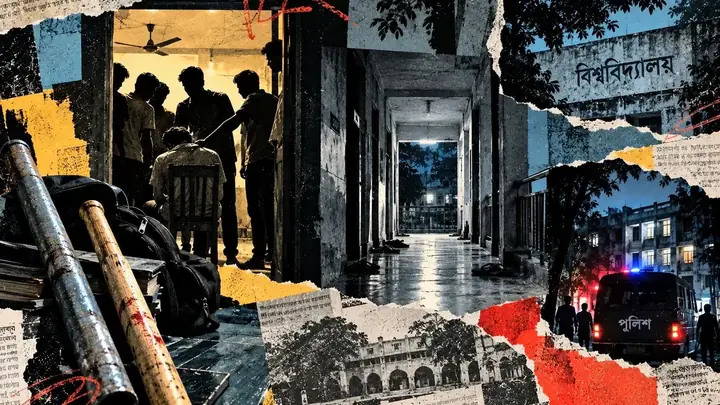
The PM must be protected. But who protects the ordinary citizen?
A journalist and a shopkeeper reported threats before they were killed. Their cases demand answers from the police.

Let us be absolutely clear about one thing. Any credible threat against Prime Minister Tarique Rahman must be treated with the utmost seriousness. His security is a matter of national importance, and the agencies responsible for protecting him must remain vigilant against even the possibility of an attack.
The recent detention of a man in Rajshahi, following a Facebook comment referring to a sniper during the prime minister's visit, shows how swiftly law enforcement agencies can respond to a potential security concern. Several units reportedly worked to identify the individual before he was detained.
There is every reason to investigate such a comment, while ensuring that any subsequent legal action follows due process.
But the incident raises a question that goes far beyond the security of one individual, however important his office may be. What happens when an ordinary citizen faces a threat to their life?
Where is the urgency when a shopkeeper reports death threats? When a journalist warns police that armed men are waiting to kill him? When a woman faces rape threats online? When someone is attacked, files a case and is then threatened again unless the complaint is withdrawn?
Consider journalist Lutfozzaman Fakir Alif, shot dead in Netrokona on October 15. Nearly 11 months earlier, on November 30, 2025, he warned the district's superintendent of police that armed men were waiting to kill him. At a meeting attended by other journalists, Alif described the threat and asked those present to bear witness. "They are waiting to shoot me when I leave," he said.
Alif had already been hacked and injured in an attack earlier that November. His family later alleged that the case filed over the assault had brought little accountability.
The superintendent of police said he instructed the officer-in-charge of Durgapur Police Station to ensure Alif's security and that Alif reported no subsequent security concerns. Police have since arrested suspects, but investigators have not established whether the earlier threats were connected to the murder.
We cannot conclude that the police ignored his warning. But what protective measures followed? Was the earlier assault properly investigated? Did officers reassess his safety? After someone has survived an attack and reported a specific threat, should the absence of another complaint be taken to mean the danger has passed?
In Rangpur, the warning came only hours before the killing. In August, Mizanur Rahman, a 46-year-old grocery shop owner, went to Mithapukur Police Station with his mother and filed a general diary after receiving death threats. On their way home, attackers intercepted them and hacked Mizanur to death as his mother begged them to stop.
Police said they had planned to investigate his complaint the following morning.
The following morning.
By then, Mizanur was dead. Nobody can say with certainty that immediate intervention would have saved him. But was his complaint assessed for immediate danger? What could the police have done before he left the station?
There are also people who face violence because they have sought legal action. In Noakhali in April, the family of a 14-year-old girl was attacked after her father filed a case accusing a madrasa superintendent of attempting to rape her. According to the family, assailants vandalised their home, assaulted relatives and demanded withdrawal of the case. Police arrested one person.
In Jashore in August, five journalists reported being assaulted twice within 24 hours, the second time after filing a case over the first attack.
A complainant should not have to choose between pursuing justice and protecting their family. Threats to withdraw a case need police attention in their own right. So does the risk of another attack.
Women facing sexual harassment and blackmail online often struggle to obtain redress. An April Daily Star investigation, citing an ActionAid study, reported that nearly 65 percent of surveyed women who had filed complaints said no action followed. Police acknowledged investigative difficulties but disputed allegations that complainants were pressured to withdraw general diaries.
Not every offensive remark is a criminal offence, nor does every threat carry an equal risk of violence. Investigations take evidence, judgement and resources. That is why police must assess each complaint rather than assume it can wait.
Articles 27 and 31 of the Constitution guarantee equality before the law and protection of the law. This does not entitle everyone to the prime minister's security arrangements. His office involves exceptional risks. But it does entitle ordinary citizens to expect that a credible threat will be assessed and, where necessary, acted upon.
Police stations need clear procedures for identifying urgent threats, following up when intimidation continues, and protecting people targeted for filing cases. Officers should record how they assessed the danger and what action they took. When someone is attacked after seeking help, those decisions must be examined.
The authorities were right to investigate the possible threat against the prime minister promptly. The home ministry should demand an account of how police handled Alif's warning and Mizanur's complaint, and whether the officers involved made any assessment of immediate danger.
Mizanur went to the police station with his mother because he feared he would be killed. He filed a general diary and set out for home. He was killed on the way.
What more was he supposed to do?