Arafat Rahaman
← Reports & Features
Reporting·

Only half the students pass

The pass rate in this year’s Higher Secondary Certificate (HSC) examination hit a 22-year low of 51.62 percent, down 5.5 percentage points year-on-year.
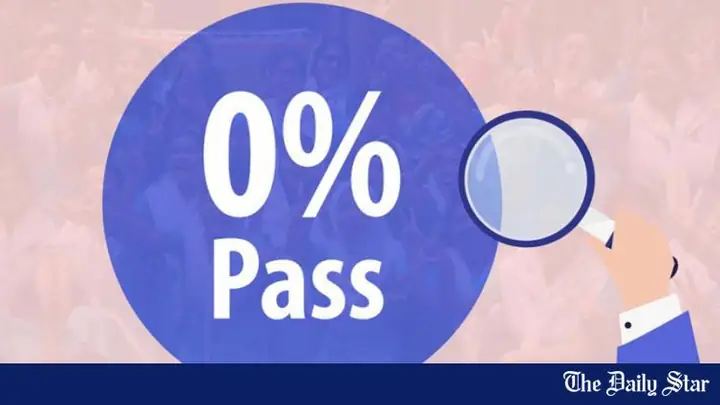
The pass rate in this year’s Higher Secondary Certificate (HSC) examination hit a 22-year low of 51.62 percent, down 5.5 percentage points year-on-year.

Unlike last year’s shortened exams, this year’s tests were held on the full syllabus, with full marks and duration. Students also said that the question paper was harder in this year’s exam.

The number of GPA-5 achievers, the highest grade in the general boards, fell 43 percent to 35,948, while institutions with zero pass rose to 181 from 177. Those with a 100 percent pass rate fell to 61 from 80.

Overall, girls have outperformed boys in terms of pass rates for the sixth straight year.

“The further decline in the HSC pass rate from last year is unacceptable,” said Education Minister ANM Ehsanul Hoque Milon while announcing the results yesterday. 

He cited learning gaps, irregular classroom teaching. and teacher shortages as possible reasons. 

“We must identify the gaps, reassess the situation and take necessary measures -- that is our responsibility,” he said, adding that special examinations for students who failed one or two subjects will be held within two months.

Expressing concern over the results, he said a re-evaluation would help determine whether there were any errors in the published results.

Applications for re-scrutiny of answer scripts will be accepted online from November 1 to 7.

He also stressed the need for greater transparency in future examinations.

“The prime minister wants students to be assessed properly so that no one is unfairly marked down,” he added.

In an unprecedented downturn, the pass rates fell across all nine general education boards this year, with more than half the candidates failing in five of them.

By comparison, only the Cumilla Board had a pass rate below 50 percent last year.

Dhaka Board recorded the highest pass rate at 61.80 percent, although it was down from 64.62 percent last year.

Barishal had the lowest pass rate at 44.84 percent, followed closely by Jashore (44.92 percent), Rajshahi (45.06 percent), Dinajpur (45.98 percent) and Cumilla (48.04 percent).

The pass rates in Chattogram, Mymensingh and Sylhet stood at 52.07 percent, 51.44 percent and 50.90 percent respectively.

Barishal saw the steepest decline, with its pass rate dropping 17.73 percentage points from last year’s 62.57 percent. Rajshahi’s pass rate fell by 14.34 percentage points, while Dinajpur recorded a decline of 11.51 points.

Irregular class attendance, inadequate classroom teaching, dependence on private coaching and students’ excessive use of mobile phones are possible reasons for the results debacle, said Sharif Morshed Reza, controller of examinations of Barishal Education Board.

Teacher shortages were particularly acute in some areas of Bhola, where government teachers are reluctant to stay.

Humanities students had the lowest pass rate among the three major groups at 42.17 percent, compared with 73.12 percent for science and 50.77 percent for business studies.

ICT pass rates fell across all nine general boards, while English results deteriorated in six. Jashore saw a particularly sharp fall in ICT, where the ICT pass rate dropped to 67.84 percent from 88.63 percent last year.

English results also deteriorated in six boards. In Barishal, English pass rate dropped to 54.08 percent from 75.16 percent last year.

Rajshahi’s English pass rate fell to 56.01 percent from 68.82 percent, while Dinajpur recorded 56.05 percent pass rate, down from 64.47 percent.

Poor performance in English was the main reason behind the board’s low pass rate, while ICT results were also unsatisfactory, said Md Abdul Matin, secretary of the Board of Intermediate and Secondary Education, Jashore.

“The standard of English teaching in educational institutions is far from satisfactory. Teachers of other subjects often teach English despite lacking adequate proficiency in the language,” he told The Daily Star.

Matin also cited the introduction of identical question papers across the nine general boards, stricter examination monitoring through CCTV cameras and improved answer-script evaluation as factors influencing this year’s results.

Milon said teacher-training programmes have been undertaken to address weaknesses in English.

Girls outperformed boys in pass rates for the sixth straight year, with 55.45 percent passing compared with 47.14 percent of boys. Boys, however, accounted for 50.5 percent of GPA-5 achievers.

The poor results reflected several interconnected problems, including learning losses during the Covid-19 pandemic, subsequent disruptions to education and persistent teacher shortages, said Rasheda K Chowdhury, executive director of the Campaign for Popular Education (CAMPE).

She also raised concerns about inequalities between rural and urban students and between children from affluent and low-income families, saying access to educational resources continued to influence academic performance.

The sharp decline in pass rates required a thorough investigation rather than conclusions based on assumptions, said Siddiqur Rahman, former director of Dhaka University’s Institute of Education and Research.

He pointed to teacher shortages for the results debacle.

“In many institutions, ICT is taught by teachers of other subjects. Most of the teaching is theoretical, with very little practical work. Simply memorising theory is not enough to learn ICT.”

He urged the government to examine why students continued to struggle in English and Humanities.

An analysis of Bangladesh Bureau of Educational Information and Statistics (BANBEIS) data suggests this is the worst outcome since 2004, when the pass rate was 47.73 percent and a majority of the candidates failed.

For the next two decades, the country moved in the opposite direction, with the pass rates hitting 93.21 percent in 2021, when the Covid-19 pandemic forced major adjustments to the examination system.

Students sat tests in shorter syllabuses and fewer subjects with reduced marks. In 2020, no public examinations were held due to the pandemic, and students were evaluated based on previous academic records.

This year, of the 1,240,798 students who appeared in the examinations under 11 education boards; 646,685 passed while 594,113 failed.

Originally published by
This article was originally published in The Daily StarFirst archived: 31 October 2026
Read original article ↗
Share

Share this story

E-paperArticle-only preview
Arafat RahamanJournalist · Bangladesh
E-PAPER
Reporting1 November 2026Education
Education

Only half the students pass

The pass rate in this year’s Higher Secondary Certificate (HSC) examination hit a 22-year low of 51.62 percent, down 5.5 percentage points year-on-year.

The pass rate in this year’s Higher Secondary Certificate (HSC) examination hit a 22-year low of 51.62 percent, down 5.5 percentage points year-on-year.

Unlike last year’s shortened exams, this year’s tests were held on the full syllabus, with full marks and duration. Students also said that the question paper was harder in this year’s exam.

The number of GPA-5 achievers, the highest grade in the general boards, fell 43 percent to 35,948, while institutions with zero pass rose to 181 from 177. Those with a 100 percent pass rate fell to 61 from 80.

Overall, girls have outperformed boys in terms of pass rates for the sixth straight year.

“The further decline in the HSC pass rate from last year is unacceptable,” said Education Minister ANM Ehsanul Hoque Milon while announcing the results yesterday. 

He cited learning gaps, irregular classroom teaching. and teacher shortages as possible reasons. 

“We must identify the gaps, reassess the situation and take necessary measures -- that is our responsibility,” he said, adding that special examinations for students who failed one or two subjects will be held within two months.

Expressing concern over the results, he said a re-evaluation would help determine whether there were any errors in the published results.

Applications for re-scrutiny of answer scripts will be accepted online from November 1 to 7.

He also stressed the need for greater transparency in future examinations.

“The prime minister wants students to be assessed properly so that no one is unfairly marked down,” he added.

In an unprecedented downturn, the pass rates fell across all nine general education boards this year, with more than half the candidates failing in five of them.

By comparison, only the Cumilla Board had a pass rate below 50 percent last year.

Dhaka Board recorded the highest pass rate at 61.80 percent, although it was down from 64.62 percent last year.

Barishal had the lowest pass rate at 44.84 percent, followed closely by Jashore (44.92 percent), Rajshahi (45.06 percent), Dinajpur (45.98 percent) and Cumilla (48.04 percent).

The pass rates in Chattogram, Mymensingh and Sylhet stood at 52.07 percent, 51.44 percent and 50.90 percent respectively.

Barishal saw the steepest decline, with its pass rate dropping 17.73 percentage points from last year’s 62.57 percent. Rajshahi’s pass rate fell by 14.34 percentage points, while Dinajpur recorded a decline of 11.51 points.

Irregular class attendance, inadequate classroom teaching, dependence on private coaching and students’ excessive use of mobile phones are possible reasons for the results debacle, said Sharif Morshed Reza, controller of examinations of Barishal Education Board.

Teacher shortages were particularly acute in some areas of Bhola, where government teachers are reluctant to stay.

Humanities students had the lowest pass rate among the three major groups at 42.17 percent, compared with 73.12 percent for science and 50.77 percent for business studies.

ICT pass rates fell across all nine general boards, while English results deteriorated in six. Jashore saw a particularly sharp fall in ICT, where the ICT pass rate dropped to 67.84 percent from 88.63 percent last year.

English results also deteriorated in six boards. In Barishal, English pass rate dropped to 54.08 percent from 75.16 percent last year.

Rajshahi’s English pass rate fell to 56.01 percent from 68.82 percent, while Dinajpur recorded 56.05 percent pass rate, down from 64.47 percent.

Poor performance in English was the main reason behind the board’s low pass rate, while ICT results were also unsatisfactory, said Md Abdul Matin, secretary of the Board of Intermediate and Secondary Education, Jashore.

“The standard of English teaching in educational institutions is far from satisfactory. Teachers of other subjects often teach English despite lacking adequate proficiency in the language,” he told The Daily Star.

Matin also cited the introduction of identical question papers across the nine general boards, stricter examination monitoring through CCTV cameras and improved answer-script evaluation as factors influencing this year’s results.

Milon said teacher-training programmes have been undertaken to address weaknesses in English.

Girls outperformed boys in pass rates for the sixth straight year, with 55.45 percent passing compared with 47.14 percent of boys. Boys, however, accounted for 50.5 percent of GPA-5 achievers.

The poor results reflected several interconnected problems, including learning losses during the Covid-19 pandemic, subsequent disruptions to education and persistent teacher shortages, said Rasheda K Chowdhury, executive director of the Campaign for Popular Education (CAMPE).

She also raised concerns about inequalities between rural and urban students and between children from affluent and low-income families, saying access to educational resources continued to influence academic performance.

The sharp decline in pass rates required a thorough investigation rather than conclusions based on assumptions, said Siddiqur Rahman, former director of Dhaka University’s Institute of Education and Research.

He pointed to teacher shortages for the results debacle.

“In many institutions, ICT is taught by teachers of other subjects. Most of the teaching is theoretical, with very little practical work. Simply memorising theory is not enough to learn ICT.”

He urged the government to examine why students continued to struggle in English and Humanities.

An analysis of Bangladesh Bureau of Educational Information and Statistics (BANBEIS) data suggests this is the worst outcome since 2004, when the pass rate was 47.73 percent and a majority of the candidates failed.

For the next two decades, the country moved in the opposite direction, with the pass rates hitting 93.21 percent in 2021, when the Covid-19 pandemic forced major adjustments to the examination system.

Students sat tests in shorter syllabuses and fewer subjects with reduced marks. In 2020, no public examinations were held due to the pandemic, and students were evaluated based on previous academic records.

This year, of the 1,240,798 students who appeared in the examinations under 11 education boards; 646,685 passed while 594,113 failed.