Arafat Rahaman
← Reports & Features
Reporting·

Hold us accountable, Bobby tells education stakeholders

State minister says government should be judged by groundwork for long-term improvements in education
State Minister for Primary and Mass Education Bobby Hajjaj today said the government should be judged by whether it is laying the groundwork for long-term improvements in education, rather than by expecting major changes within a few months.

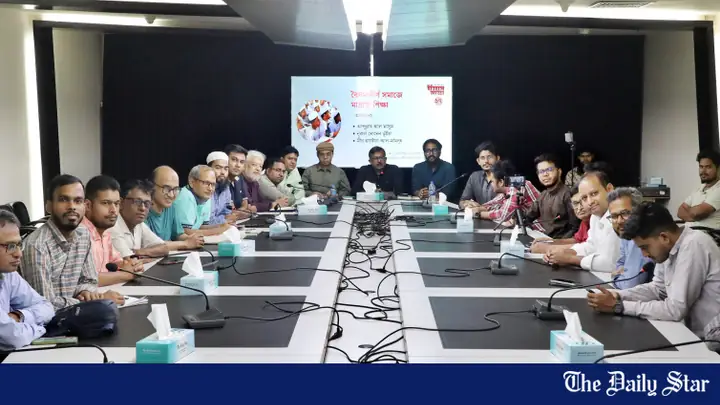
“We want you (stakeholders) to hold us accountable. We will try, we will make mistakes, and you should point out our mistakes,” he said at a national dialogue on the government’s progress in primary education in Dhaka.

The dialogue was organised by the Citizen’s Platform for SDGs, Bangladesh, with the Centre for Policy Dialogue serving as its secretariat.

Bobby said meaningful change in education could take years and the immediate question should be whether the government was taking steps that could produce results in two, five or 10 years.

On school feeding, he said the government planned to extend the mid-day meal programme to all primary schools from next year. It was also considering a small pilot of cooked meals within the next year. “Cooked meal is the best meal,” Bobby said.

On teacher management, he said the Directorate of Primary Education was preparing a new policy covering recruitment, career progression, assessment and training. The DPE has been asked to submit its first draft to the ministry by October.

“We want to move quickly, but we do not want to rush,” he said.

Bobby acknowledged teacher shortages in the Chattogram Hill Tracts, where recruitment is handled through district councils rather than directly by his ministry. He said the government was working with the councils and the ministry responsible for the hill tracts to address the issue.

On the Primary Education Development Programme, Bobby questioned whether the existing structure remained suitable. He said PEDP-type programmes had been necessary when they began more than two decades ago, but putting infrastructure, learning improvement, ICT and other activities under a single programme made management and transparency more difficult.

“Building a building is one task, and improving students’ learning is another,” he said.

The state minister said the government wanted to move towards single-shift schools but lacked the infrastructure to introduce the system nationwide. He also said NCTB had been asked to examine differences in school hours between single- and double-shift institutions.

On curriculum reform, Bobby said the ministry was working with NCTB and setting up advisory mechanisms involving child psychologists and early-learning experts. He said curriculum development should go beyond textbooks and consider learning objectives, school hours and children’s overall development.

Bobby said the government wanted greater consistency across education streams, with common standards in curriculum, teacher quality, training and infrastructure. Private Bangla-medium and English-medium institutions would be brought under the new curriculum and government monitoring by 2028, he said.

He said the government was also examining how school management committees could function better and would continue engaging with teachers, educationists and civil society as reforms moved forward.
Originally published by
This article was originally published in The Daily StarFirst archived: 19 September 2026
Read original article ↗
Share

Share this story

E-paperArticle-only preview
Arafat RahamanJournalist · Bangladesh
E-PAPER
Reporting19 September 2026Education
Education

Hold us accountable, Bobby tells education stakeholders

State minister says government should be judged by groundwork for long-term improvements in education

State Minister for Primary and Mass Education Bobby Hajjaj today said the government should be judged by whether it is laying the groundwork for long-term improvements in education, rather than by expecting major changes within a few months.

“We want you (stakeholders) to hold us accountable. We will try, we will make mistakes, and you should point out our mistakes,” he said at a national dialogue on the government’s progress in primary education in Dhaka.

The dialogue was organised by the Citizen’s Platform for SDGs, Bangladesh, with the Centre for Policy Dialogue serving as its secretariat.

Bobby said meaningful change in education could take years and the immediate question should be whether the government was taking steps that could produce results in two, five or 10 years.

On school feeding, he said the government planned to extend the mid-day meal programme to all primary schools from next year. It was also considering a small pilot of cooked meals within the next year. “Cooked meal is the best meal,” Bobby said.

On teacher management, he said the Directorate of Primary Education was preparing a new policy covering recruitment, career progression, assessment and training. The DPE has been asked to submit its first draft to the ministry by October.

“We want to move quickly, but we do not want to rush,” he said.

Bobby acknowledged teacher shortages in the Chattogram Hill Tracts, where recruitment is handled through district councils rather than directly by his ministry. He said the government was working with the councils and the ministry responsible for the hill tracts to address the issue.

On the Primary Education Development Programme, Bobby questioned whether the existing structure remained suitable. He said PEDP-type programmes had been necessary when they began more than two decades ago, but putting infrastructure, learning improvement, ICT and other activities under a single programme made management and transparency more difficult.

“Building a building is one task, and improving students’ learning is another,” he said.

The state minister said the government wanted to move towards single-shift schools but lacked the infrastructure to introduce the system nationwide. He also said NCTB had been asked to examine differences in school hours between single- and double-shift institutions.

On curriculum reform, Bobby said the ministry was working with NCTB and setting up advisory mechanisms involving child psychologists and early-learning experts. He said curriculum development should go beyond textbooks and consider learning objectives, school hours and children’s overall development.

Bobby said the government wanted greater consistency across education streams, with common standards in curriculum, teacher quality, training and infrastructure. Private Bangla-medium and English-medium institutions would be brought under the new curriculum and government monitoring by 2028, he said.

He said the government was also examining how school management committees could function better and would continue engaging with teachers, educationists and civil society as reforms moved forward.